

You know that moment when you’ve been staring at the problem on your computer screen for so long that your vision is getting wonky and you are getting nowhere, so you go to re-caffeinate yourself… and then, as you are staring out the window, making the tree outside go in and out of focus… the answer just strolls into your head, fully formed?

Shower epiphanies, treadmill insights, “I solved the slide deck while unloading the dishwasher” moments. Those aren’t accidents. They’re a feature of how your brain solves complex problems when you stop trying to mercilessly push your mind up a metaphorical hill.
That “off” time has a name in the research: incubation. And if you care about thinking clearly, creating excellent work, and not spending your life staring dead-eyed at your spreadsheet or deck, it’s worth understanding.
Particularly for my fellow “type-A-continuous-driving-rest-is-healthy-for-everyone-but-me” personality types. Listen up.
What Is “Incubation?”
In 1926, the social psychologist Graham Wallas outlined his model of the creative process in a book titled The Art of Thought. In this work, Wallas brilliantly framed the brain dance between conscious and unconscious thought that is necessary for creativity.
Here is the short, sweet version.
- Preparation: You study, research, and grapple with the problem.
- Incubation: You step away from the “active brain work” and let it simmer in the background.
- Illumination: BOOM. The “aha” moment.
- Verification: You go back to your initial work to check, refine, chart a course of action, and implement.
Incubation is that middle zone where you look unproductive to everyone (including yourself). You’re walking, showering, folding laundry. But under the surface, your brain is still quietly crunching.
A century later, the basic idea holds up: giving a problem some distance often improves your ability to solve it.
A 2009 meta-analysis of 117 studies found a reliable positive incubation effect on problem solving, especially for creative problems. People who took breaks generally did better than those who hammered at the problem continuously.
Confirmed by science: taking a break to get a cup of coffee and walking up and down the office stairs a couple of times to distract yourself and get your blood moving can boost your productivity and problem-solving.
What Is Your Brain Doing When It Is “Doing Nothing?”
More science for our science nerds! When you stop doing focused work and your mind drifts, a specific network in your brain lights up: the default mode network (DMN). The DMN includes regions in your medial prefrontal cortex, posterior cingulate, and temporal lobes. These areas are involved in memory, self-reflection, and imagining alternatives.
The DMN is active when you’re:
- Remembering the past
- Simulating the future
- Daydreaming
- Spinning social scenarios in your head at 2 a.m.
The DMN is having a PARTY when you are engaged in creative thinking and creative flow state, but interestingly it is also activated when you are in that liminal space of slightly-zoned-out, but kinda-thinking-about-stuff state, which is why flashes of brilliance often come to us while doing mundane tasks like taking a shower, driving to work, or rewatching a show that you have seen a bunch of times. The DMN loves distraction, ie, easy, undemanding tasks. That’s the sweet spot for bursts of illumination. It is the Goldilocks Rule — not too hot, not too cold — the brain needs to be relaxed, but active.
The DMN is what allows your brain to roam through stored experiences and connect things that normally don’t sit next to each other.
During incubation, you’ve already “loaded” the problem into your brain machine (Wallas’ preparation stage), and the DMN is roaming around, noticing things and connecting dots.
During incubation, the DMN is:
- Reactivating fragments of the problem
- Pulling out related memories and concepts
- Trying out weird associations without your conscious veto system online
In other words, when you step away, you’re not abandoning the problem. You’re handing it over to a different system (the DMN), which is better at creative integration than brute force.
A big meta-analysis backs this up: incubation helps most when the break activity is low cognitive load, not highly demanding, and not just pure “sit in a chair and suffer with your thoughts.”
So the recipe is not just “take a break and stare at a wall.” It’s:
Load the problem → Switch to an easy, mildly engaging activity → Let the mind drift around it without forcing it.
Sorry, TikTok Doesn’t Count
If you’re thinking, “Sweet, research says I should live on my phone,” sadly, no.
Not all “off” time is equal. TikTok doesn’t count.
High-stimulation activities (doomscrolling, fast-cut videos, inbox triage) compete for the same attention and working-memory resources you need for the problem itself. They don’t leave cognitive slack for the DMN to roam. You’re just feeding your brain more noise.
Ideal activities are soft-focus activities that allow your focus to drift in and out:
- Walking without a podcast
- Showering
- Light chores
- Casual drawing, playing an instrument, listening to classical music
- Gentle exercise
- Being in nature without trying to “optimize” it
Time in nature is particularly effective for incubation and creative thinking, partly via attention restoration (your directed attention gets a rest) and partly by supporting gentle shifts between external “soft fascination” and internal mind-wandering. And nature doesn’t have to be a trip to a national park. Going outside, wandering around, and looking at trees also counts.
How To Proactively Incubate
Here’s how to turn this into a repeatable habit rather than a rare shower miracle.
1. Do real preparation first
Incubation only works if there’s something in the mental blender.
That means:
- Clarify the problem in a single sentence.
- Gather key constraints, data, or examples.
- Try at least one or two deliberate attempts to solve it.
- Capture everything in one place so your brain has a coherent “packet” to work with.
In Wallas’ four-step framework, this is your preparation stage. Skipping this and calling it “incubation” is just procrastination.
2. Schedule intentional “off” blocks
Allow (even schedule) yourself 10 to 20-minute windows where you will not actively work on the problem, and also will not bombard yourself with high-stim content.
Good examples:
- Walking around the block without your phone
- Doing dishes
- Watering plants
- Light stretching
3. Have reasonable expectations
Ideas often show up half-baked and badly timed. If your brain offers a connection or weird angle during incubation, capture it immediately. Write it down. No, really, write it down (or record it in a voice memo, put it into your notes app, or send yourself a text).
Don’t rely on “I’ll remember that later.” You won’t. Future you is busy.
4. Close the loop
Incubation isn’t the whole process. You still need to get to Step 4 of Wallas’ framework, verification: checking whether the idea actually works, stress-testing it, and closing the loop.
So the next time you’re stuck, resist the urge to double down on misery at your laptop. Load the problem into your brain and let it have a little bit of “autopilot” time. You might be surprised at what you get.
In a moment of pause,
AB


The World’s Most Fun Leadership Newsletter (Probably).
Subscribe for free. Stay for the honesty, chaos, and a weekly leadership reality check.
🎁 Holiday SALE:
Before everyone scatters into travel lines, gravy clouds, and whatever version of family chaos awaits, I’ve got a little something to tuck in your back pocket. We’re dropping exclusive holiday discounts for TWO Human Solution experiences unlike anything we’ve offered before. Consider it a pre–holiday-coma treat for Future You.
🧰 SmartStart:
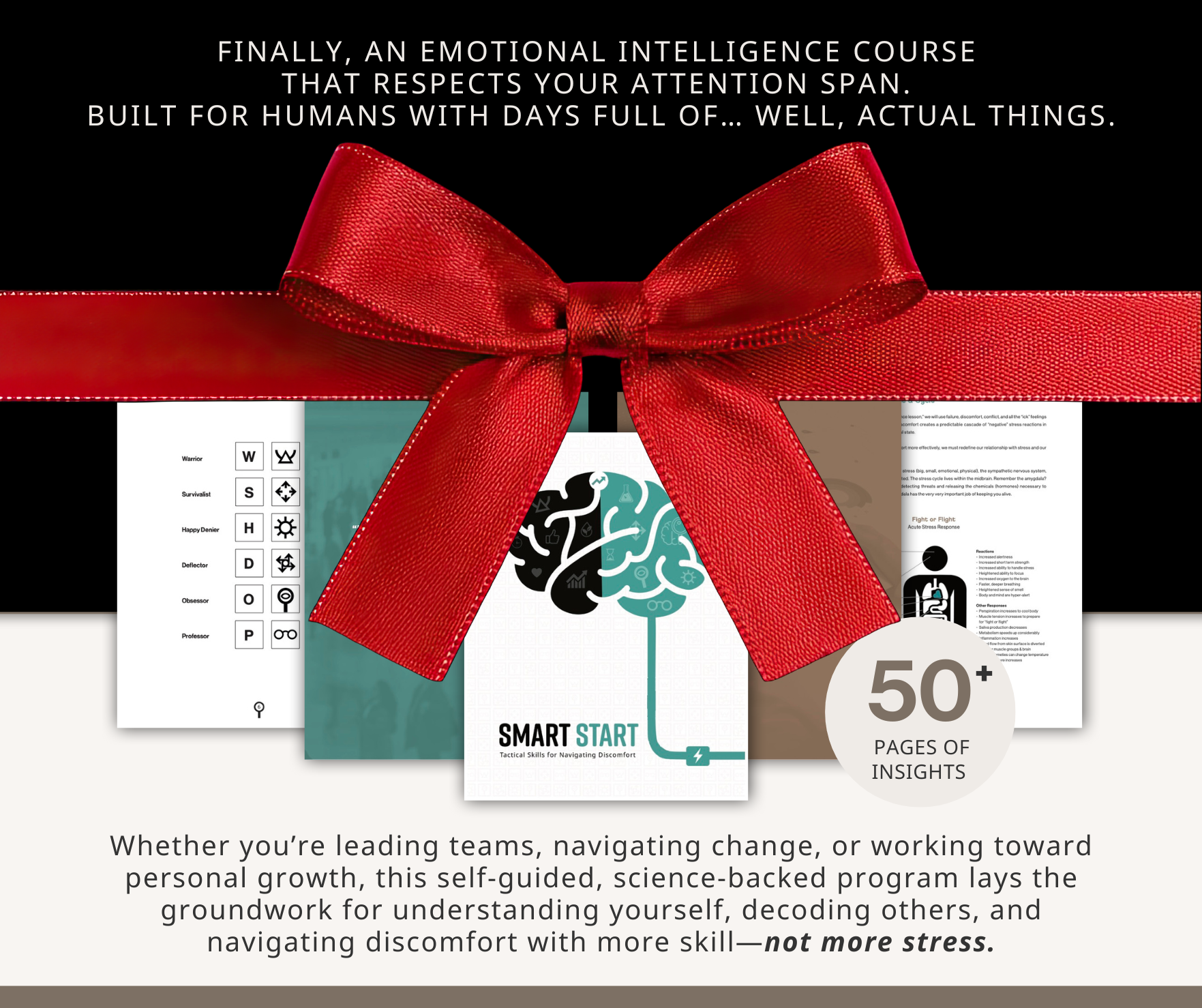
If you’re craving a tiny rebellion against end-of-year chaos, SmartStart is a beautiful way to spend a sliver of your holiday downtime. It’s the kind of self-awareness reset that slips in between naps, pie slices, and ignoring group texts—so you roll into 2026 not running on fumes, but actually knowing your default response to failure, stress & discomfort. Because nothing says “new year, new clarity” like giving your future self a head start.
→ $199 Register HERE + use coupon code HOLIDAY to SAVE $$$.
📸 Personal Branding Experience:
If SmartStart is the work you do on the inside, our exclusive Personal Branding Headshot experience with yours truly, Elise Kutt, is the glow-up the outside has been waiting for. Think of it as a matched set: the emotional intelligence upgrade and the portrait that proves it. Step into the new year with a headshot that looks like the most grounded, self-aware version of you—because when your inner clarity and outer presence line up, people feel it before you even say a word. This is the experience that brings both halves of the story together.
→ $249 Book HERE (No coupon code necessary)

🧰 Free Leadership Resources: