

We built a company around helping humans interact better with other humans. So why are we writing about AI?
Unless you have been living gloriously off-grid for the past couple of years, you have noticed that technology is moving at a freakish pace and shaping every single corner of modern work. You do not need to sell software to be shaped by software. Tech may not be your product, but it is 100% part of your operating environment. This is true if you are a school teacher or a robotics engineer. It influences how people communicate, make decisions, build, collaborate, and lead. Like it or not, we are all swimming in the tech pool now.
Here is what I have observed, particularly in the last 6-9 months (through my own work and work with others). There are several types of AI User personas.
- The GPT-Googler: These people are using AI as Google 2.0. Search, summary, information retrieval. Faster Google. Cleaner output. And the AI talks to you like you are their best and funniest friend. Useful? Absolutely. Amazing if you want to know all about the characters’ backstories in Yellowstone and whether Kevin Costner really owns a ranch. (Yes, he does. He owns a 160-acre ranch in Colorado called the Dunbar Ranch, named after his character in Dances with Wolves. Just in case you are not a GenX-er and didn’t already make that connection.)
- The Believer in Fairy Godmothers & Genies: These people believe in magic and use AI like their own personal fairy godmother or genie in a lamp. Write a term paper. CHECK! Create a synthesis report. CHECK. Always wanted to write a novel? Easy, peasy, lemon-squeezy. Of course! My AI totally knows my voice. I will have something for you in 2.5 minutes. As most of us have discovered, quick and easy doesn’t always translate to high-quality and risk-free.
- The Thinkers & Collaborators: These are the people that I find very interesting. These people are using AI as a thought partner, research assistant, sounding board, and iterative workbench. These people are the people who are saying to their AI, “Here is what I think. I have little evidence to back it up. Punch holes in it. Am I totally nuts? Interesting. How about this? Let’s go again.” These people are using AI to iterate, iterate, iterate. They are using AI as a second set of hands to push ideas and work through the sludgy, messy process of bad ideas, first drafts, and critical feedback.
Users 1 & 2 are basically extractive, and I say that descriptively, not pejoratively. They are using it to extract information from the vast expanse of information available to AI. User 3 is evolving from extraction into collaboration, and once we are talking about collaboration, we are talking about communication, and the quality of the interactions starts to matter a whole lot.
This is the part that has our attention. Because at that point, using AI starts to feel a lot less like searching and a lot more like managing. You are setting direction. Providing context. Clarifying what good looks like. Catching what is off. Redirecting tone. Pushing for nuance. Checking accuracy. Deciding what is usable, what is generic nonsense, and what still requires a distinctly human hand. And spoiler alert, a whole bunch of it still needs a human hand.
In other words, the people getting the deepest value from AI are not just the most technical. They are the people with excellent communication skills and know how to direct work well.

The more we use AI, the less it feels like magic and the more it feels like managing a very smart, very fast, occasionally overconfident intern. Helpful? Absolutely. Capable of saving real time? Yes. Also fully capable of handing you something polished, plausible, and just wrong enough to create problems if you stop paying attention.
Which is why I keep coming back to the same conclusion: management skills are becoming the hard currency in the age of AI.
There is absolutely nothing wrong with using AI for extraction. In fact, it is excellent for exactly that. Summarize this. Compare these. Pull the themes. Distill the article. Organize the notes. Save me twenty minutes of internet wandering.
Great. Love that for us.
But extraction is not where the real shift is happening.
The bigger shift is what happens when people move from using AI to retrieve information to using it to shape thinking. That is the line between convenience and leverage. Once AI becomes part of the actual process of figuring something out, the human role changes too.
You are no longer just looking for answers. You are framing problems. Testing approaches. Trying language. Rejecting mediocre directions. Pushing for sharper distinctions. Asking better follow-up questions. Reminding the machine of the real point, because somewhere in the last three prompts, it totally lost the thread. Knowing when to fully start over because holy cow, you and your AI-beau have managed to just make a big pile of gibberish, and “NO, that is not what you meant.”
Seriously. Deep breath. Walk away, get a snack. Come back and try again.
That kind of interaction requires a very different set of skills than search.
It requires judgment and patience. Two traits that will be the golden ticket. Traits that become more valuable, not less, when everything around us gets faster.
This is one of the great ironies of the current moment. For years, many organizations have treated communication, feedback, discernment, and people-centered leadership as “soft” skills. Important, maybe. Nice to have, sure. But somehow secondary to technical skill, domain expertise, or measurable output.
AI is exposing how wrong that framing has always been.
Because once a system can generate language, structure, options, analysis, and plausible-sounding output at speed, the differentiator is no longer just who can produce more. The differentiator becomes who can guide, refine, evaluate, and decide.
That is not a side skill. That is the actual work.
A lot of people are still talking about AI as though the central challenge is learning how to prompt it correctly. Yes, clear prompting matters. But the deeper skill is not prompting. The deeper skill is direction and management.
What does good look like? When will we collect feedback? How do you best receive information? These are questions that come directly from our people management training!
Here are a few more thought experiments that are particularly relevant for AI interactions:
- Can you distinguish between a rough draft and a final product?
- Can you recognize when something is technically competent but strategically dead?
- Can you tell when a piece of writing is organized but lifeless?
- Can you tell recommendation is efficient but tone-deaf?
- Can you recognize when WE HAVE LOST THE PLOT?!?!?
This is the work of good managers and supervisors. They do not just assign tasks. They create enough clarity for useful work to happen. They provide context. They define standards. They identify what is missing. They redirect when something is off. They understand that the quality of the outcome depends heavily on the quality of the interaction. These are the same skills that make the difference with AI use.

ALERT. ALERT. ALERT. The real danger for all of us is that AI can produce a lot of output very quickly, which makes weak direction even more dangerous, not less. A vaguely managed team creates confusion. A vaguely managed AI workflow can create confusion at scale. Also, side note: When the work gets crappy, AI does not care. You are the one on the line.
I think this may be part of the reason that so many people have an unsatisfying first experience with AI. They assume the value is in getting the answer (see GPT-Googler above). But when AI is being used as a thought partner, the real value is in the back-and-forth. In the iteration. In the supervisory work around the answer.
The first draft is not the point. The conversation with the draft is the point. This is the meaningful work, and you can’t skip the meaningful work. The people who get the most out of AI know how to respond to imperfect work productively. They are experts at setting clear expectations and delivering feedback (DING! DING! DING! Management skill alert!). Expectation setting and feedback are not decorative, “soft” leadership skills. They are core operating skills in any environment where drafts, ideas, and outputs need refinement.
AI is not making human skill obsolete. It is making human skill easier to see. It is making it painfully obvious that speed is not wisdom. Fluency is not judgment. Volume is not quality.
My prediction is that the speed of AI will widen the chasm between mediocre and excellent work.
The future of work will not be neatly divided between those who use AI and those who do not. We zoomed right past that marker. The more meaningful divide will be between people who use AI to extract and people who use it to enhance their thinking.
That is a leadership divide.
I didn’t mean for this article to be a bunch of predictions, but here we are. We can come back later to see if I was right. Another prediction, here you go. I predict that the next meaningful advantage will not belong just to technical experts, but to people who know how to guide cognitive labor well, whether that labor comes from a human, a machine, or an increasingly messy combination of both.
Because the more AI becomes part of how we think, write, build, and lead, the more obvious it becomes that communication, judgment, feedback, discernment, and boundaries were never “soft” skills. They were always the core infrastructure.
XO,
AB
The World’s Most Fun Leadership Newsletter (Probably).
Subscribe for free. Stay for the honesty, chaos, and a weekly leadership reality check.
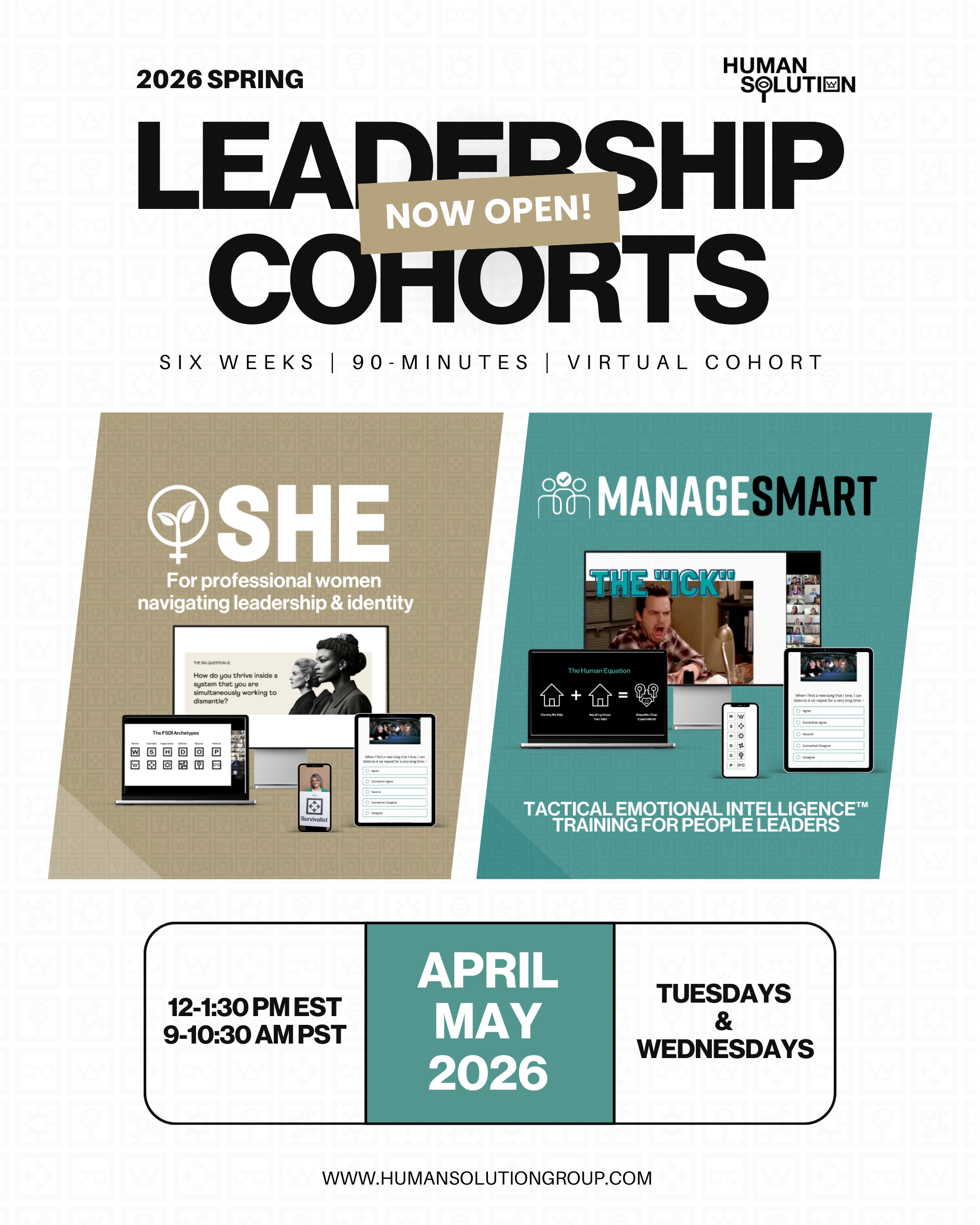
🌸 Spring Cohorts Are OPEN!
This spring, we’re hosting two live, six-week leadership cohorts designed for humans who lead real people in real situations.
SHE and ManageSmart are fully virtual, highly interactive programs grounded in Tactical Emotional Intelligence™—helping leaders build the clarity, confidence, and communication skills that actually show up at work.
Whether you’re navigating your identity as a leader or managing people day-to-day, these cohorts offer practical tools you can use immediately—not theory that lives in a notebook.
Enrollment is now open for Spring 2026. Learn more HERE.
🧰 Free Leadership Resources: