

Congratulations, your LLM has become your newest direct report. Think of it like you are now responsible for managing a very booksmart intern. And for those of us who have experience managing interns, you know that it is not as easy as you might think.
The integration of AI into workflows has become inevitable. It is no longer a novelty tool that sits alongside work. We need to start thinking of it as part of the operating system of how work gets done.
We have crossed the threshold. McKinsey’s 2025 global AI survey found that 88% of respondents say their organizations are regularly using AI in at least one business function. Microsoft and LinkedIn’s 2024 Work Trend Index found that 75% of global knowledge workers are using AI at work, and 78% of those AI users are bringing their own AI tools to work.
Which means AI is here. Whether organizations and individuals know how to use it well is another question.
AI is an amplifier. It makes MORE. More speed. More content. More drafts. More options. More brilliance AND more junk. AI can accelerate the movement from idea to artifact. It can help us draft faster, prototype faster, test faster, and make a big ol’ mess faster.
The more we work with AI, the more obvious this becomes: using AI well is not simply a matter of technical skill. Yes, of course, there are tools to learn, and that can feel overwhelming. So many platforms. New releases and upgrades every day.
Just six months ago, the idea that every individual person, regardless of field or position, would “have their own tech stack” seemed ludicrous. Now…not so crazy.
But let’s not lose the forest for the trees.
The most important skill has been, and continues to be, knowing how to lead work through the translation and distribution of ideas.
And guess what? Those are people leadership skills.
Not because AI is human. It is not.
But because AI, at its best, is a tool of reflection, collaboration, and execution. An overconfident, often verbose collaborator who does not always understand context, nuance, audience, constraints, or values.
If you have ever managed people, especially talented but under-contexted people (Hello, super eager booksmart intern), this starts to feel familiar very quickly.
You cannot expect another entity, human or machine, to read your mind, infer your standards, understand your audience, know your constraints, honor your values, and magically produce the thing you meant but did not articulate.
You cannot just toss a vague request into the void and expect brilliance.
AI is making that leadership communication gap painfully visible.
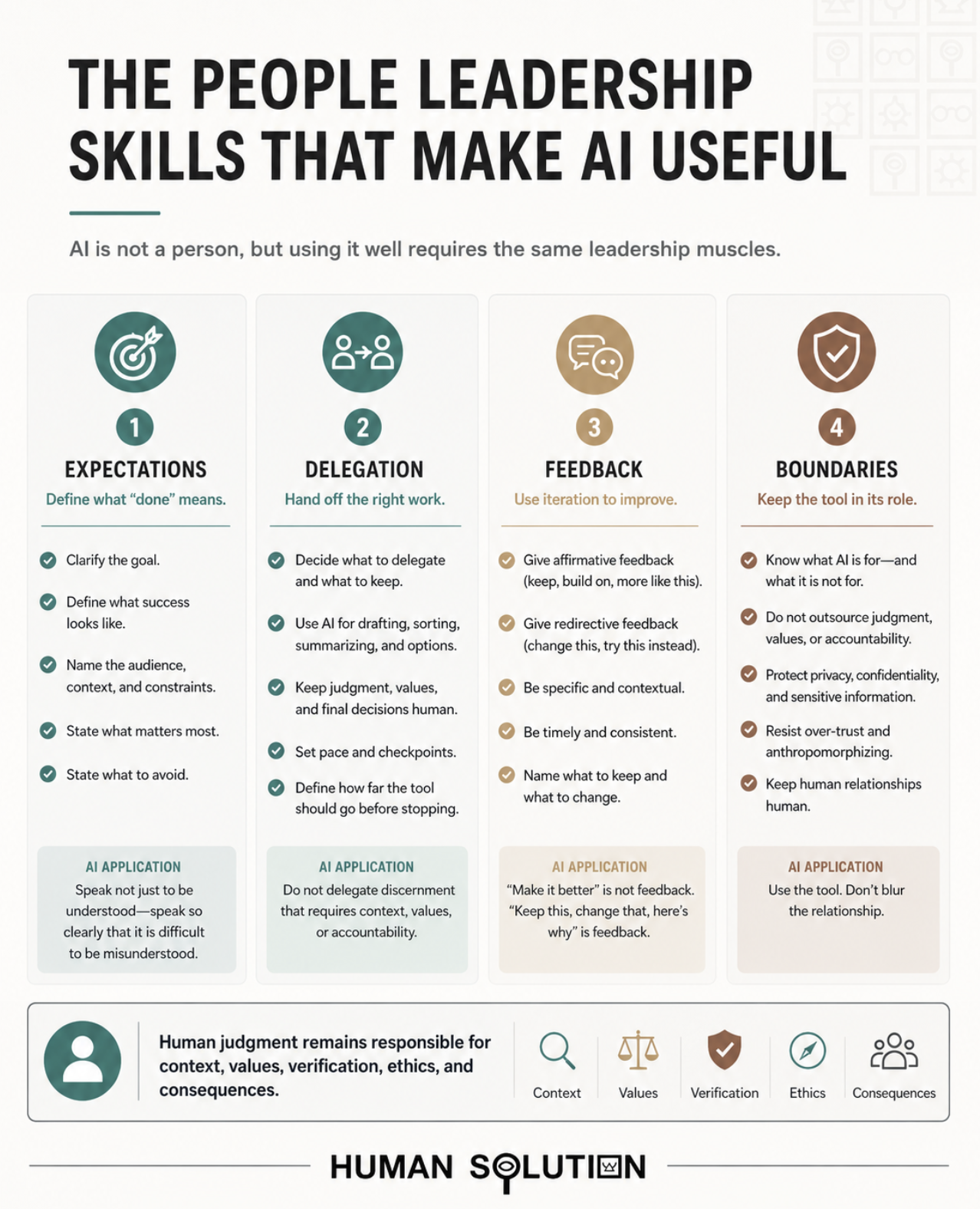
And this is why thinking about AI management skills, like people leadership skills, is so helpful. For non-technical people, it makes AI feel more accessible. AI stops feeling like mysterious robot-magic and starts feeling like a familiar leadership challenge:
How do I set expectations?
How do I decide what to delegate?
How do I give useful feedback?
How do I create boundaries around the interaction?
For people who are already deep in AI, the frame does something different. It reconnects the conversation to humanity. Under all the language about automation, agents, optimization, productivity, and workflows, the work is still human work.
The tool is new. The leadership work is not.
🧰 Free Leadership Resources:
The Creative Agility Index

The CAI was not designed to tell people whether they are creative. It assumes that to be human is to be a creative, meaning-making, storytelling being.
It asks the more interesting and useful questions:
How does creativity move through you?
Where do you navigate possibility?
How do you shape ideas?
The CAI is designed as a mirror for creative behavior and skills: a way to recognize your creative default, your growth edge, and the role you most naturally play in the life of an idea.
Because the world is not slowing down, and we all need to refine our skills of adaptation, reimagination, deconstruction, reconstruction, discernment, and critical thinking. All of these skills begin with self-awareness and curiosity.
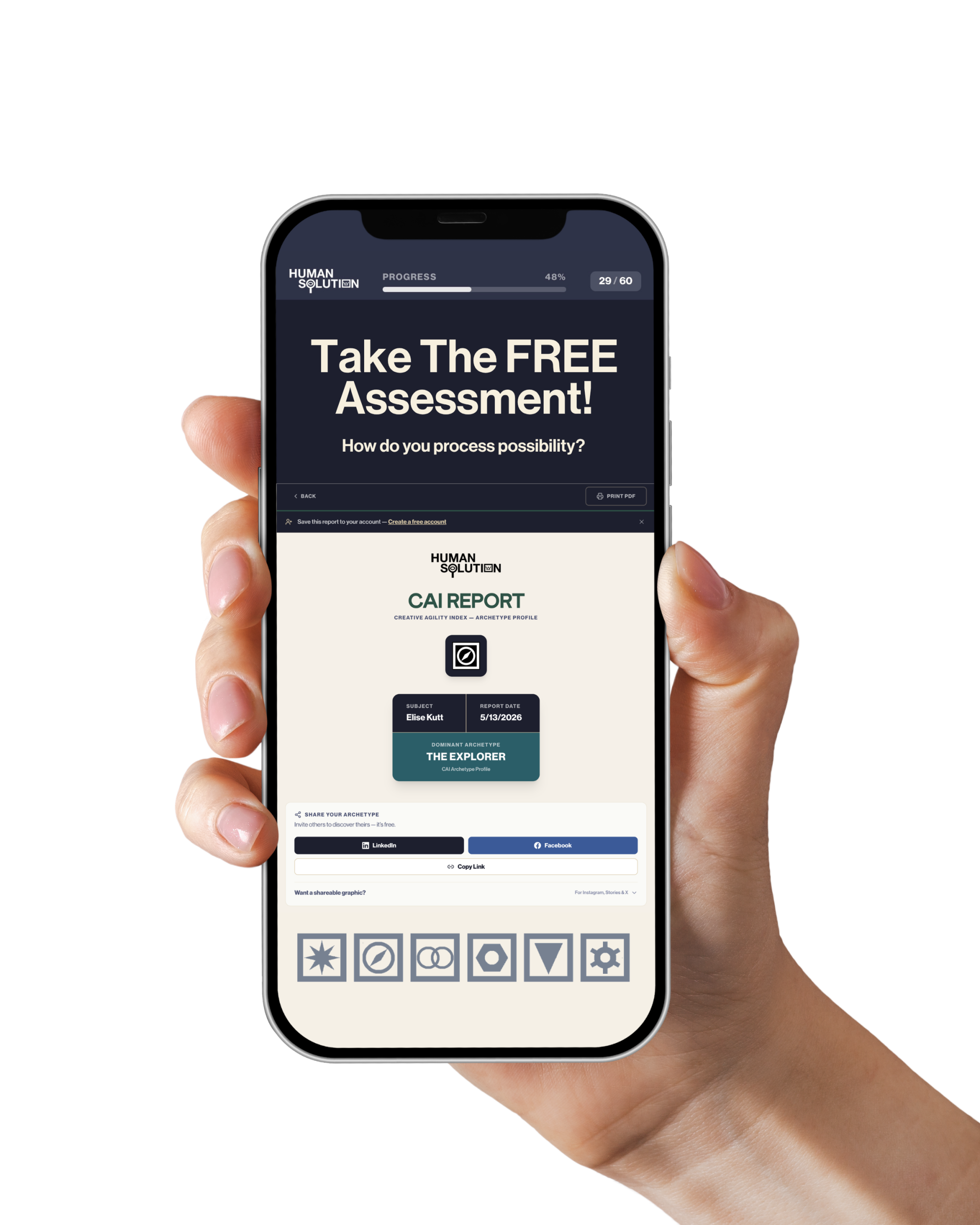
Take the Quiz. Find Your Archetype.