
The science of nourishing creativity without forcing it
As a grown-up human, I am consistently amazed at how often I have to remind myself to chill the hell out, have a little more fun, and hold life just a tad more lightly. I don’t know exactly how it happens, but somehow, somewhere, the work of adulting just takes over. I have been thinking about it a lot, particularly as we have been diving deep into the creativity and curiosity work.
At some point, the grown-ups have gotten confused and started treating innovation like something that can be bullied into existence. Schedule a brainstorm. Add a whiteboard. Block out time on your calendar for “deep work.” And I am not saying that these tactics aren’t good. They are good. But they are operational tactics. And fundamentally, operational tactics are about supporting and executing conceptual things — ideally, creative things, ideas with energy, life, and human spark (says the person who loves operational tactics). 🫣
Creativity is not a vending machine. YOU are not a vending machine.
You cannot insert urgency and receive insight.
Which begs the questions
- What does creativity need?
- How do you architect the conditions that nurture creativity?
Creativity needs inputs. It needs space. It needs friction. It needs divergence, convergence, and the tension between the two. It needs contact with other humans. It needs time away from the thing. It needs receptive human nervous systems.
The internalization of creativity as an inherent trait of an individual is relatively new, like 1950’s new. The idea that a person IS a genius, rather than a person who has been touched by genius, is fairly modern, like Romantic era modern.
I love the more ancient historical idea of the human as a vessel receiving creative inspiration. Language is so fun. The word inspiration comes from the Latin inspirare, meaning “to breathe into” or “to blow into.” I think this idea is magical both conceptually and functionally. It takes the focus from being the brilliance (that’s a lot of pressure), and instead turns it toward nurturing “the vessel” (aka you) to be ready to recognize, receive, and cultivate possibility and opportunity. (Note: Elizabeth Gilbert talks about this beautifully in THIS TED talk and in her book Big Magic)
So, if the work is to architect and nurture the vessel, how do you do that? Here are a few science-backed ideas to contemplate, ideas backed by enough research, lived experience, and basic human common sense to be worth taking seriously. They are also wonderfully unglamorous and actionable, which I appreciate. #survivalistarchetype
Nature
If you have been with us for a while, you know we are going to keep trying to push you outside. Stress reduction, creativity nurturing — bottom line, more exposure to nature = a good thing. There is a growing body of research suggesting that time in nature supports attention, restoration, mood, and creative problem-solving. One study* found that people who spent several days immersed in nature, away from technology, performed significantly better on a creative, problem-solving task than people tested before the trip.
The National Human Activity Pattern Survey found that Americans spend about 87% of their time inside enclosed buildings and another 6% in enclosed vehicles. We are now a species of mammal that spends most of its time inside boxes (house box, car box, office box, grocery store box) looking at boxes (computer box, TV box, phone box).
Now, before we all run into the woods or totally dismiss the nature thing because we definitely can’t go live off the grid, there is an important caveat. In the study referenced above, nature and disconnection from technology were conflated. Was it the trees? Was it the sunshine? Was it the absence of notifications? Was it the walking? Was it the expansive horizon (as opposed to the tiny horizon of a smartphone screen)? Um, the answer is, “Yes. All of the above.”
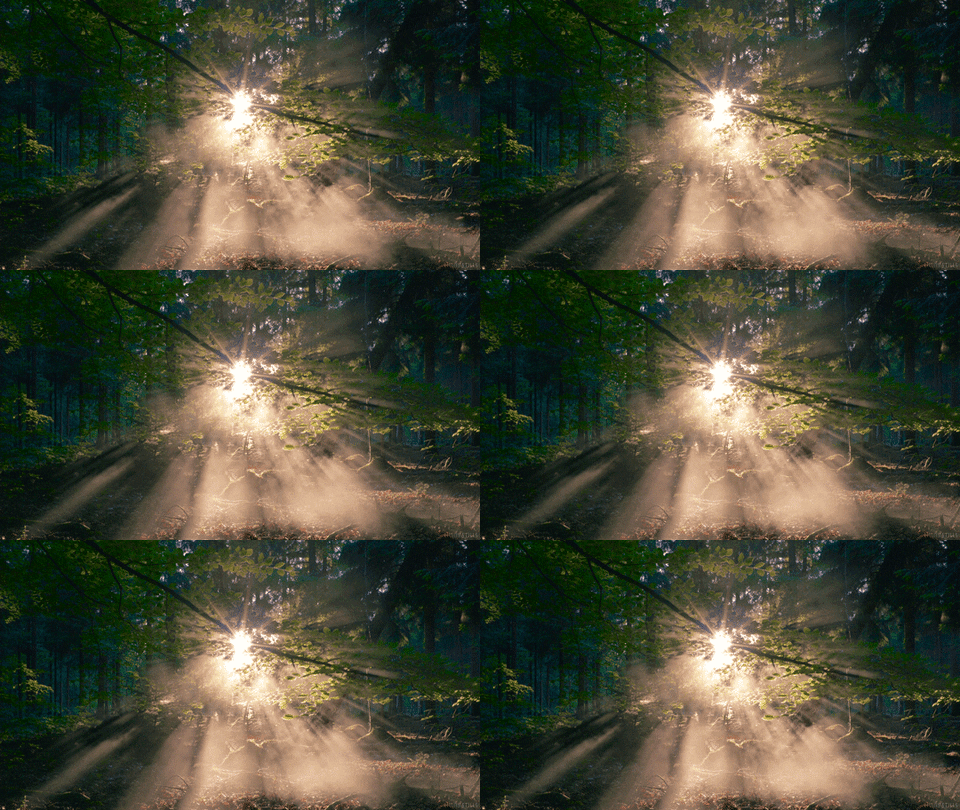
Nature helps because it changes the conditions around the brain. It softens the demand load. It broadens attention without requiring constant decision-making. It offers what researchers often call “soft fascination”: enough sensory engagement to hold us gently, not so much that we have to wrestle with our own attention.
Most of modern life is hard attention-seeking. Pings. Alerts. Cars. Screens. Deadlines. Even our leisure time is often chopped into tiny attention pellets. In short-form video, marketers increasingly treat the first three seconds as the “hooking period, ”the tiny window before you get swiped into oblivion.
Nature gives the brain a very different kind of stimulus and input. Nature gives the mind a little more room, a broader horizon, both literally and figuratively.
This does not mean we all need to disappear into a national park (although there are worse ideas). It can be smaller than that. Drink your coffee on the porch without your phone. A walk before the meeting. Ten minutes outside after a difficult conversation. And maybe book that trip to the national park.
Networks
We love the story of the solitary creative mind: the artist in the attic, the founder in the garage, the misunderstood visionary wandering around with a small black notebook and poor social skills.
This is a both/and situation. Solitude matters. Focus matters. Independent thought matters. But creativity can also be deeply social. Ideas may gel inside a single brain, but the inputs come from all over. They come from contact. Conversation. Misunderstanding. Translation. Borrowed language. A comment someone makes offhandedly that embeds itself into the right mind at the right time. A question from someone outside your field. A disagreement that irritates you for three days until you finally unpack why it mattered.
Networks feed creativity because they give our brains access to more raw material. People who think differently than we do. People with different training, different roles, different identities, different tolerances for ambiguity, different relationships to risk, different levels of patience for our nonsense. Intellectual diversity and diversity of lived experience matters.
A closed network can be comfortable, but creatively stale. People tend to settle into their roles and there is comfort in the reliability of expected interactions. But to enhance creativity, we need to proactively seek a little more friction. Not hostility or toxicity, but healthy friction. Different angles. Different language. Different stakes. Combined with enough trust for unfinished thinking to exist without being immediately shut down.
This does not mean every idea needs group processing and a committee. OMG, no. Save us from death by committee <gasp gasp>. But, ideas, particularly ideas that have the potential to impact a lot of people, do need diverse inputs and spaces and relationships conducive to productive feedback loops. It needs people that will say, “Wait. Say more about that weird part. I don’t think I quite understand it. Have you thought about this…”
Novelty
Networks feed right into our next “N,” novelty. Creativity loves surprise, delight, and even a jolt of confusion. Novelty gives the brain new ingredients. I have a client that runs an imaginative futuring organization, and her go-to strategy tool is a “WTF element.” A “WTF element” does not have to be extreme (it can be, sometimes that is fun). It can simply be surprising, novel, or a little out of the ordinary. The point is to disrupt our unconscious patterns and shock our brain into new thought patterns. Change the environment. Introduce something new. Play.
Examples of “WTF elements” could be:
- Why is this room full of puppies?
- Yes, we are going to have this conversation while taking a walk, rather than sitting in a conference room.
- No, you can’t sit in the same seat you always sit in. Today we are all going to sit in different seats and see the room from a new perspective.
- Good job on this strategy framework, now spend the 30 minutes outlining how you would execute it in a zombie apocalypse.
- Yes, it is purposeful that our strategic planning afternoon is taking place in the public museum.
- Brush your teeth with your non-dominant hand. If you are feeling extra adventurous, put the top back on your toothpaste with your non-dominant hand, you wild-child.
- Try a new sport or physical activity. Sit in the discomfort of being kinda bad at something new.
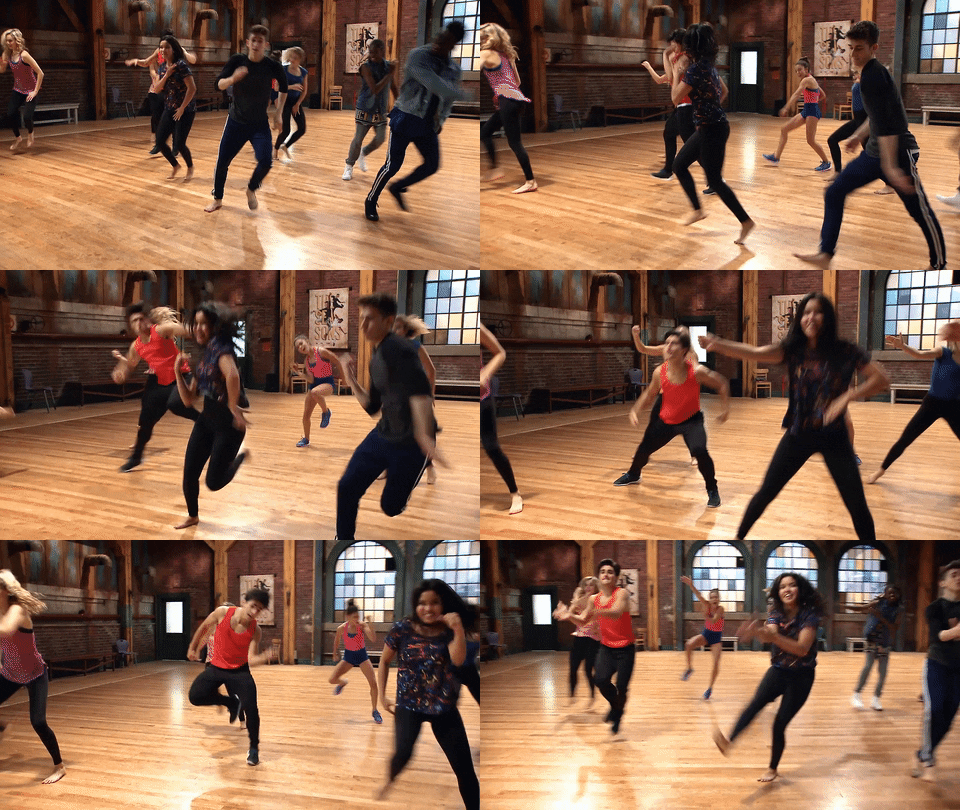
Research on diversifying experiences suggests that active engagement with unusual, unexpected, or schema-violating experiences can increase cognitive flexibility. That phrase — active engagement is important.
Watching someone else do something weird is not the same as being in a new situation yourself and/or actively applying an outside perspective to an internal process or problem. Hosting your strategic planning in the public museum is great. A change of venue is good for human brains. Even better? Give your team time to wander around and absorb their environment, with the express assignment of discovering something that is relevant to your organization’s strategy.
Novelty works best when we are involved enough that our brain has to update its operating system.
A new place. A new skill. A new route. A new kind of conversation. A new material. A new audience. A new constraint. A new question. A new way of looking at a familiar problem. Novelty interrupts our defaults.
Again, novelty does not have to be dramatic. You do not need to upend your entire life. Novelty can be small and deliberate. Novelty is not about chasing stimulation like a maniac, it is about giving the mind something fresh enough to work with.
A little disorientation can be useful (and fun).
Naps
Yes, naps. By naps, I mean more than literal naps, though literal naps are included, there is science backing the benefits of the siesta.
I am using naps as shorthand for sleep, rest, incubation, mind-wandering, and the often counterintuitive truth that a lot of the actual work/growth happens when we stop actively trying SO hard. This is particularly difficult for the Type A grinders and overachievers who really believe that we can arm wrestle creativity (and everything else) into submission through the power of our will. Oof.
This is where productivity culture gets twitchy. Because rest and incubation do not look like work. A walk, a shower, a nap, a quiet drive, folding laundry, staring out the window — none of this looks like work.
I was recently in Paris, and all of the cafes position their little outside chairs facing out to the sidewalk. And Parisians sit in those chairs with their coffee just staring out into the street. Very few phones or computers, the occasional journal or book lying open on a table — just watching the world. Sometimes people are chatting, but mostly they are just hanging out, absorbing the world around them, drinking their coffee. As an American tourist, it is striking, and, truthfully, a little confusing. But proof that a phone-free-morning coffee is possible.
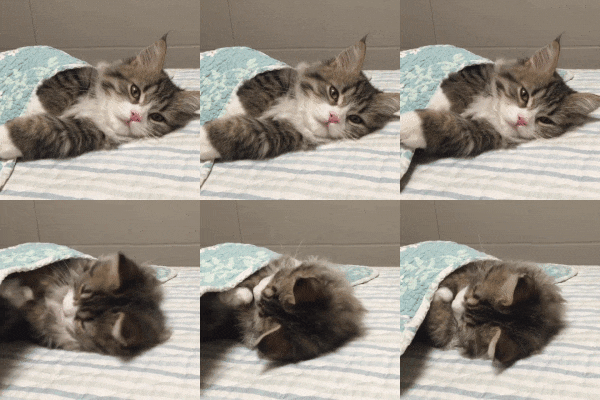
The brain is not inactive in these in-between moments. It is observing and associating. Sorting. Recombining. Loosening. Making connections below the level of conscious effort.
Research on mind-wandering and incubation suggests that undemanding tasks can help creative problem-solving. Specifically, not tasks that consume all attention. Not frantic multitasking. Simple tasks that give the mind room to move on multiple levels.
This is why ideas show up in the shower, on the drive to work, or while you are folding laundry. Flashes of brilliance while you are completing mundane tasks.
It is not because the shower has mystical properties, though I remain open to the possibility. It is because the shower is one of the last socially acceptable places where we stop performing competence for seven to twelve minutes.
Sleep matters too. REM sleep has been linked to associative processing and creative problem-solving. Which is a science-backed way of saying: sometimes your brain needs you to shut up and lie down.
This is hard for high-capacity people. The people who are most used to being useful often distrust rest. We want to keep pushing. But we need both the effort and the rest. It is like weight lifting. The lifting days feel like the work, but the gains happen on the rest days.
Feeding is not forcing
Nature, networks, novelty, and naps all feed creativity in different ways. Nature restores the system. Networks diversify the system. Novelty disrupts the system. Naps integrate the system.
The idea that creativity is simply a personal trait that you either have or do not have is just bunk. Let’s throw that idea out. Creativity is much more contextual than that. It is shaped by the conditions we build around ourselves and one another. This matters personally, but it also matters organizationally. Because a lot of workplaces claim to want creativity while actively starving the conditions that support it. They want big ideas from people with no breathing room, and innovation from teams with no trust. They ask for agility from people who are punished for taking an experimental misstep.
That is not how it works. It is not how humans work.
Creativity cannot be forced, but it can be fed.
So go outside. Talk to someone interesting. Do something unfamiliar. Take the nap.
XO,
AB
Take the Quiz. Find Your Creativity Archetype.
* Atchley, R. A., Strayer, D. L., & Atchley, P. (2012). “Creativity in the Wild: Improving Creative Reasoning through Immersion in Natural Settings.” PLOS ONE, 7(12), e51474.
🧰 Free Leadership Resources:
The Creative Agility Index

The CAI was not designed to tell people whether they are creative. It assumes that to be human is to be a creative, meaning-making, storytelling being.
It asks the more interesting and useful questions:
How does creativity move through you?
Where do you navigate possibility?
How do you shape ideas?
The CAI is designed as a mirror for creative behavior and skills: a way to recognize your creative default, your growth edge, and the role you most naturally play in the life of an idea.
Because the world is not slowing down, and we all need to refine our skills of adaptation, reimagination, deconstruction, reconstruction, discernment, and critical thinking. All of these skills begin with self-awareness and curiosity.
Take the Quiz. Find Your Archetype.