
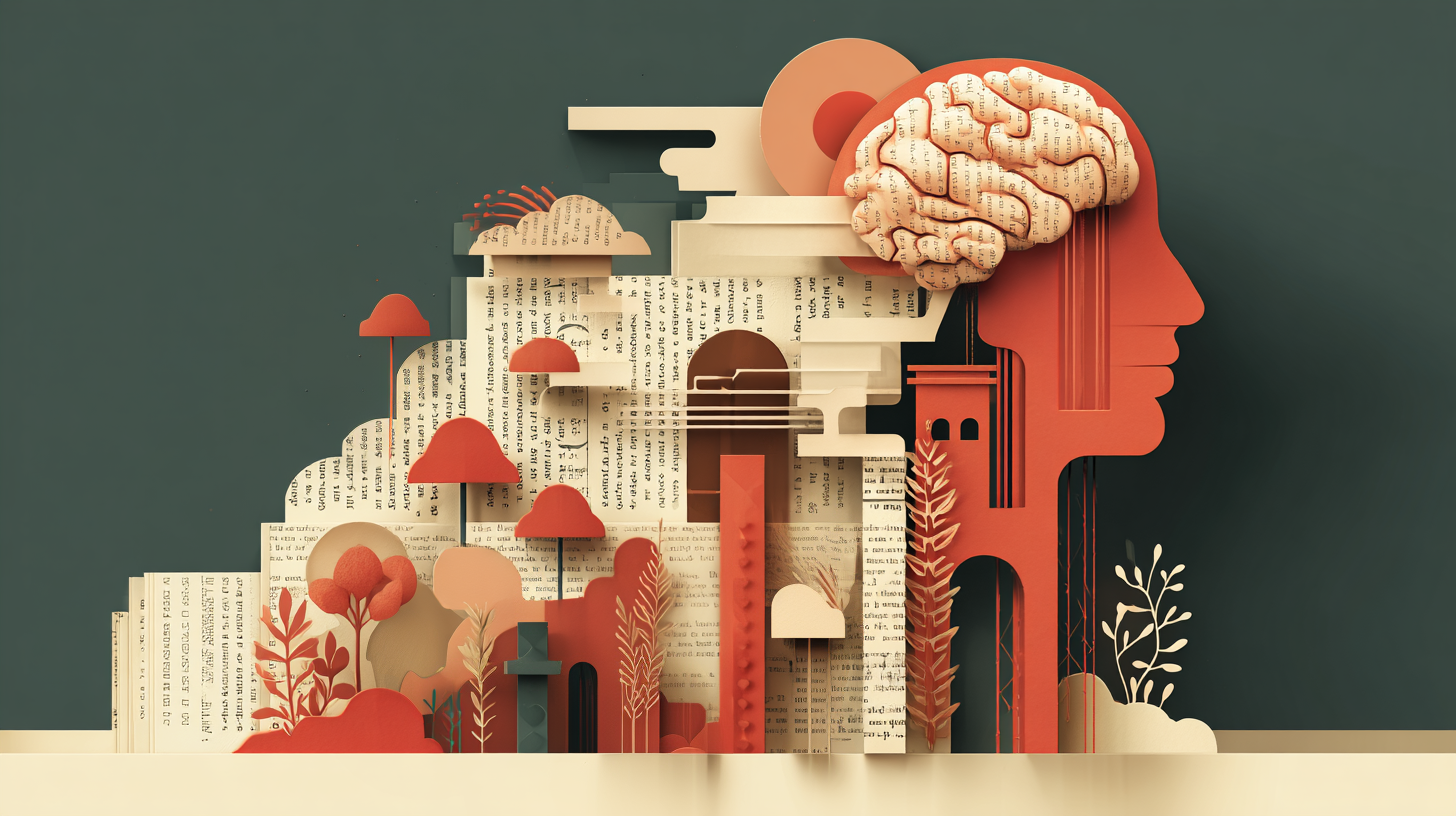
This past month, we have been busy making a crazy kind of mess.
Not a bad mess. The kind of mess that starts with, “Hmmm…let’s poke around this software and see what it can do.” And three weeks later, you wake up, deep down a vibecoding rabbit hole, entirely rethinking your relationship with SaaS products, and wondering how this world became your life.

For those who are interested, here is a little peek behind the curtain.
Because the deeper we get into building with AI, the more one thing keeps becoming obvious:
AI may make building faster, but it does not make creativity simpler.
If anything, it makes the real labor of creativity easier to see.
Setting the Stage: What is Required to Navigate Change?
In the work we do, we constantly dialogue with people in the midst of some form of change or transition, and, as we talk about quite a bit, the speed of change is not slowing down anytime soon.
Handling change well requires a couple of things.
- Next-level skills at sitting-in, managing, and navigating discomfort. This is where we have spent the majority of our attention for the last several years. And if you are hanging out with us, it means that you are actively a part of this conversation. Fact: Change and transition are inherently uncomfortable. How you deal with that stress will make an enormous impact on your success, failure, and overarching sustainability.
But there is more…Navigating discomfort is only one piece of the puzzle. Thriving in a complex, dynamic, rapidly changing system requires more.
2. Handling change well requires innovation, creativity, and agility. Creativity in the real-world, work-through-the-mess, make-something-useful-under-pressure sense.
Why We Started Building the CAI
- What are the actual skills of innovation and creative agility?
- How do people access different types of creativity?
- What actual skills are required to change course, imagine a new solution, or react to an unforeseen situation?
These are the questions we have been obsessed with for the past six to twelve months. I think we have a bad habit of treating creativity as the domain of a special group of people. The artists. The visionaries. The naturally imaginative. The people with the right job title or the right kind of brain.
But I don’t think that is true. As humans, we are all storytelling, meaning-making creatures. We are all constantly interpreting, adapting, solving, rearranging, imagining, and responding. We are all capable of creative problem-solving.
The question “Are you creative?” is somewhat moot because we are all called to respond to change.
The more useful questions are:
How do you process possibility?
How do you work with creativity?
Let’s keep going:
How do you generate ideas?
How do you shape them?
How do you move them forward?
What happens when the work gets messy?
What happens when the idea is fragile, unfinished, or under pressure?
That line of thinking is what led us to start building the Creative Agility Index (CAI)
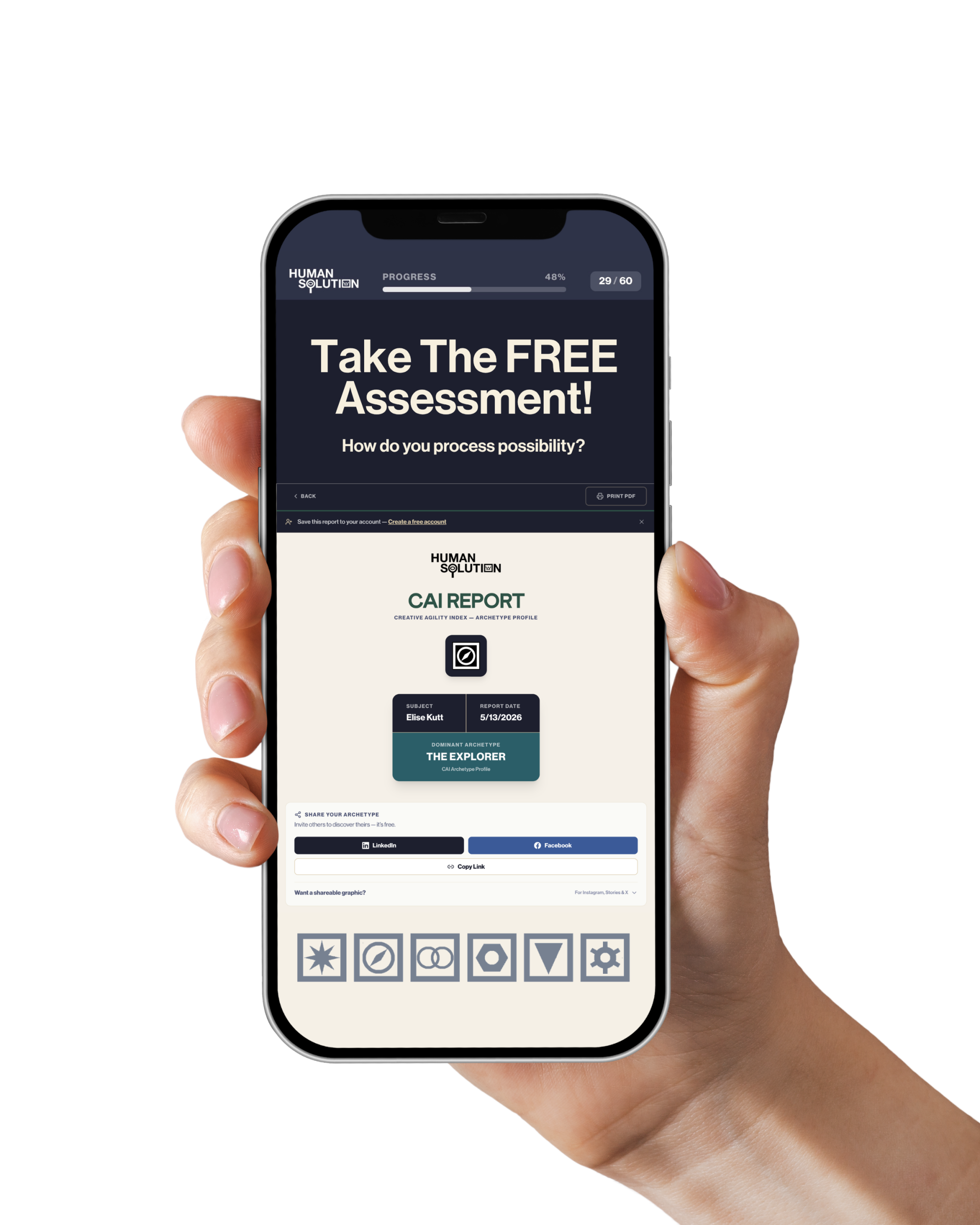
The CAI grew out of a couple of core beliefs:
- To be human is to be creative.
- Creative competencies can be learned.
That is an entry point into a richer conversation:
- What are the learnable skill sets that support creative problem-solving?
- How can we help people understand their own patterns and strengthen their range?
That is what the CAI is designed to explore.
Not creativity as a personality badge. Creativity as a practice.
Okay, if you have made it all the way to this part of the story. Thanks for staying with me. I am getting to the AI part.
The Platform Problem
While we were building the conceptual architecture for the CAI, we were also researching platforms capable of delivering the kind of multi-assessment experience we wanted to create.
And NOTHING was working.
Or, more accurately, things were working in that deeply irritating way where something is almost right, which somehow wastes even more of your time than if it were clearly wrong.
We did not just need a platform that could deliver an assessment. We needed something flexible enough to support the bigger vision. We wanted the capacity to hold multiple instruments. We wanted synthesis. We wanted room to build connections across assessments over time. We wanted something that could eventually help us surface the more interesting human questions that live at the intersections.
In other words, we did not want a container. We wanted a system.
And the more we looked, the more we kept landing in the same place:
Close. But not close enough.
The “Well, I Guess We’re Building It” Moment
What happened next still feels a little ridiculous.
A week.
That is how quickly AI can collapse the distance between curiosity and commitment.
One minute, you are exploring an idea. Poking around inside the free version of a vibecoding tool. Three hours later, you are deep down a rabbit hole, talking about architecture, flows, UX design, functionality, logic, and edge cases, as if this was always the plan and you were always a Tech Bro.
It was not always the plan. But I might be a Tech Bro now. So, here we are.
We are actively building our own platform. The FSDI lives there. The CAI is coming. We now have the capacity to create synthesis reports between the two assessments. The larger Human Solution Suite is beginning to take shape. And the process of building it with AI has been both confusing and clarifying in ways I did not fully expect.
What AI Speeds Up, and What It Doesn’t
The advances in the AI landscape over the last 6-12 months are staggering. With 3 cans of Celsius <insert energy drink of your choice> and a dream, we are now at the point where average, regular non-coding humans (like me) can build complicated software interfaces. There is a lot of conversation right now about how AI accelerates creation.
That part is true.
- It can accelerate drafting.
- It can accelerate prototyping.
- It can accelerate problem-solving.
- It can accelerate the movement from idea to artifact.
We are living that reality firsthand.
But speed is not the same thing as creativity.
And acceleration is not the same thing as clarity.
What building with AI has made painfully obvious is that once the barrier between idea and artifact starts collapsing, the hard part of the work changes shape.
The question is no longer just:
Can you make something?
That part is getting easier, or at least faster.
The harder question becomes:
Can you work with possibility well?
- Can you tell the difference between an exciting idea and a distracting one?
- Can you recognize when something is almost right but not quite there?
- Can you shape rough energy into something coherent?
- Can you keep going when the work gets murky, repetitive, vulnerable, or frustrating?
- Can you tell what belongs in version one and what is just your inner overachiever wearing a clever disguise?
That is where the real creative labor lives.
Creativity Is More Than Ideation
I think this is where a lot of the talk about creativity goes sideways. We tend to over-focus on ideation. Brainstorming. Big swings. Inspiration. The spark. And yes, that part matters. Of course it does. But anyone who has actually built anything knows that ideation is only one slice of the pie.
Creativity is also:
- editing
- discernment
- sequencing
- adaptation
- timing
- resilience
- refinement
- restraint
- deciding what to cut
- deciding what to keep
- surviving the ugly middle
- staying with the work long enough to make it real
That is why the word agility matters so much.
Because agility implies movement. Range. Responsiveness. The ability to shift without collapsing. The ability to stay in relationship with the work as it changes shape.
Which is to say: the ability to create in real life.
What Building With AI Is Teaching Me
The more we build with AI, the more visible certain truths become.
- AI can help generate options. You have to develop the initial strategy.
- AI can help produce artifacts. You have to know whether the artifact is worth making.
- AI can help us move faster. You have to slow down enough to know if you are running fast in the right direction.
- AI can help us draft. You have to audit for coherence.
- AI can get us to version one quickly. It cannot save us from the work of versions two, three, and four.
- Perhaps most importantly, AI can synthesize, but the quality of the synthesis depends entirely on the knowledge corpus on which it is trained.
That is not a criticism of AI. It is just a reminder that the human role does not disappear when the tools get better. In some ways, it becomes even more important.
Faster building = More content = More need for discernment
What Feels True Right Now
If I had to boil this whole season of work down to one core idea, it would be this:
AI has radically collapsed the distance between idea and prototype. But it has not replaced the need for creative agility and discernment. If anything, it has increased the need.
So, have fun creating in this brave new world. We can’t wait to see what y’all come up with, and stay tuned for some fun new stuff from us. It is on the horizon!
XO,
AB
🧰 Free Leadership Resources: